Showing posts with label Type - Tree. Show all posts

Rain Tree - Samanea Saman


Rain Tree - Samanea saman

Common Name: Rain Tree
Scientific Name:  Samanea saman
Height: up to 82 ft (up to 25m)
Span:  up to 132 ft (40 m)
Growth Rate:  Fast
Sun Tolerance:  Full Sun
ABP Index: 3.0 (Aesthetics 3.0, Solidarity 3.0)

Albizia saman common name is Rain Tree. It is native to south America but was introduced to South and Southeast Asia, as well as the Pacific Islands, including Hawaii. It is a fast growing evergreen tree. It grows up to 25 m (82 ft) in height and a spread of 40 m (130 ft). The evergreen leaves are alternate, bipinnate, 25–40 cm long, with 2–6 pairs of pinnate, each of which bears 6–16 paired stalks-less leaflets, with a glandular dot between each pair. It blooms pink or yellow flower in summer. It is very fast growing large tree. So people like to plant it for fast harvest wood. The wood is soft, lightweight and takes a beautiful finish but is often cross-grained and difficult to work. It is used for furniture, general construction, and interior trim, for boxes and crates, paneling, plywood, and veneer. In Central American oxcart wheels are made from cross sections of trunks.

Rain Tree

Rain Tree Leaves

Rain Tree flowers yellow

Rain Tree Flower pink

Rain Tree fruits (pod)

Rain Tree seeds

Rain Tree Bark

Rain Tree Huge

Rain Tree Furniture

Rain Tree Ornamental
For more information:

Video of Rain Tree:


Cobra Spruce - Picea Abies 'Cobra'


Cobra - Picea abies

Common Name: Cobra Spruce
Scientific Name: Picea abies
Height: up to ft (up to 7 m)
Span:  up to 10 ft (up to 2.8 m)
Growth Rate:  Slow
Sun Tolerance: Full Sun
ABP Index: 3.0 (Aesthetics 3.0, Solidarity 3.0)

Picea abies 'Cobra' commonly known as Cobra spruce. A full growth tree looks like a Cobra snak heade and low branches rise up off the ground like cobras. It grows 25 ft (7m) in height some time more. It is a evergreen tree. Demonstrating both weeping habit as well as extreme shoot elongation, Cobra spruce is one of the more bizarre appearing conifers, but it is easy to become a fan of this new cultivar. Odd appearing in youth, Cobra grows into its own after a few years. The lowest branches often will form a skirt right on the ground. Neither the flowers nor the fruit are ornamentally significant. The smooth gray bark is not particularly outstanding. The fruit are cones. It is a slow growing plant. This tree does best in full sun to partial shade. Its relatively fine texture sets it apart from other landscape plants with less refined foliage.

Cobra Spruce - Picea abies 'cobra' Young Plants

Cobra Spruce - Picea abies 'cobra' Leaves

Cobra Spruce - Picea abies 'cobra' Cone

Cobra Spruce - Picea abies 'cobra' Seeds

Cobra - Picea abies in garden

Cobra Spruce - Picea abies 'cobra' in wild

Cobra Spruce - Picea abies 'cobra' as ornamental

For more information:

Video of Cobra:


Cherry Blossom – Prunus Serrulata


Cherry Blossom – Prunus serrulata


Common Name: Japanese Cherry
Scientific Name:  Prunus serrulata 
Height: 26-39 ft (8-12 m)
Span:  26-39 ft (8-12 m)
Growth Rate:  Fast
Sun Tolerance:  Full Sun
ABP Index: 3.5 (Aesthetics 4.0, Solidarity 3.0)

Prunus serrulata common name is Japanese Cherry also called Hill Cherry, or Oriental Cherry or East Asian Cherry. It is a species of cherry native to Easter Asia Japan, Korea and China.  It is small deciduous tree. It grows 26-39 ft (8-12 m) in height. The leaves are arranged alternately, simple, ovate-lanceolate. Every leaf is 5–13 cm long and 2.5–6.5 cm broad, with a short petiole and a serrate or doubly serrate margin. At the end of autumn, the green leaves turn yellow or red. It blooms pink flowers in spring. People celebrate the Cherry Blossom Festival when it blooms in spring. The National Cherry Blossom Festival is a spring celebration in Washington, D.C., commemorating the 1912 gift of Prunus serrulata Japanese cherry trees from Tokyo to the city of Washington. They are planted in the Tidal Basin park. P. serrulata is manly cultivates as a flowering tree. People plant it in their garden or in the Park.


Cherry Blossom

Cherry Blossom Leaves

Cherry Blossom New Leaves

Cherry Blossom Flowers

Cherry Blossom Flowers

Cherry Blossom Fruits

Cherry Blossom Bark

Cherry Blossom Log

Cherry Blossom in autumn

Cherry Blossom as ornamental
For more information: 

Video of Cherry Blossom:


Okanaiwa Banana - Musa Coccinea


Okanaiwa Banana - Musa Coccinea

Common Name: Okanaiwa Banana 
Scientific Name:  Musa Coccinea
Height: up to 8 ft (up to 3.3 m)
Span:  3–6 ft (0.8 – 1.6 m)
Growth Rate:  Fast
Sun Tolerance: Full Sun
ABP Index: 2.5 (Aesthetics 4.0, Solidarity 1.0)

Okanaiwa Banana, scientific name is musa coccinea. Other common name is Red-Flowering Banana. It is native to Tropical China and Vietnam. The flower cluster is more rounded than in the related species M. beccarii. The tree grows up to 3.3 m (8 ft) in height. The evergreen leaves are grows up to 1 m long, 25 cm wide, Narrowed gradually to a rounded tip.   It is made up of erect spirals of red bracts which enclose tubular yellow flowers. The fruits are red, only about 2 cm (0.8 in) long, and contain seeds. The species is cultivated for its ornamental value, being grown, for example, along with heliconias in commercial farms in Hawaii. People also like to plant in their garden for its red fruits.

Okanaiwa Banana : Trees

Okanaiwa Banana : Flower

Okanaiwa Banana : Flowers

Okanaiwa Banana : Fruits

Okanaiwa Banana

Okanaiwa Banana

Okanaiwa Banana

Okanaiwa Banana : Leaves

Okanaiwa Banana

Okanaiwa Banana

Okanaiwa Banana
For more information:

Okanaiwa Banana Video :


Temple Pillar - Polyalthia Longifolia


Temple Pillar - Polyalthia Longifolia

Common Name: Temple Pillar 
Scientific Name:  Polyalthia Longifolia
Height: over 30 ft (over 10 m)
Span:  4–6 ft (1.2 – 1.6 m)
Growth Rate:  Fast
Sun Tolerance: Full Sun
ABP Index: 4.0 (Aesthetics 4.0, Solidarity 4.0)

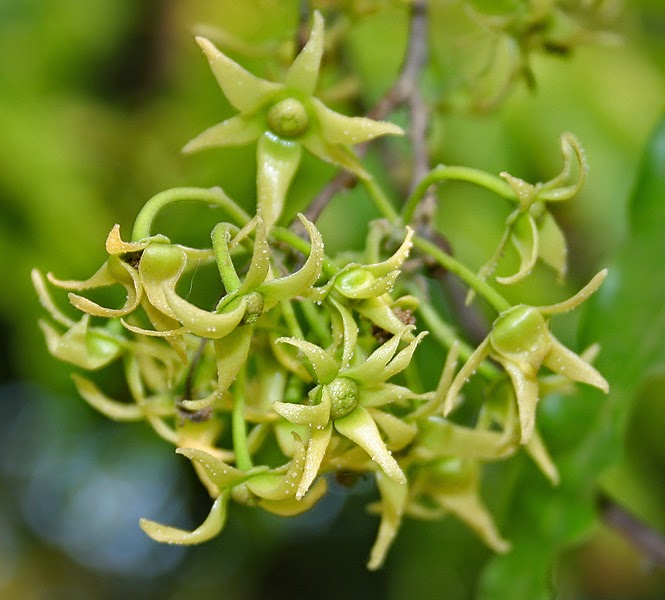
Polyalthia longifolia common name is Temple Pillar. It is mainly native India and Bangladesh. In India and Bangladesh it is called Devadaru. It is a lofty evergreen tree and commonly planted due to its effectiveness in alleviating noise pollution. The tree is known to grow over 30 ft in height. One might mistake it as a tree with effectively no branches, but in fact a Polyalthia allowed to grow grows into a normal large tree with plenty of shade. Fresh leaves are a coppery brown color and are soft and delicate to touch; as the leaves grow older the color becomes a light green and finally a dark green. The leaves are shaped like a lance and have wavy edges. The leaves are larval food plant of the kite swallowtails.In spring the tree is covered with delicate star-like pale green flowers. The flowers last for a short period, usually two to three weeks, are not conspicuous due to their color. Fruit is borne in clusters of 10-20, initially green but turning purple or black when ripe. The leaves are use for ornamental decoration and are used in festivals

Temple Pillar

Temple Pillar : Leaves
Leaves of Temple Pillar

Temple Pillar Fresh Leaves

Temple Pillar Flowers

Temple Pillar Flowers

Temple Pillar 

Temple Pillar Fruits

Temple Pillar Seeds

Temple Pillar Bark

Temple Pillar Young Plants

Temple Pillar : as ornament

Temple Pillar

For More Information:

Temple Pillar Video:

LIKE us on Facebook